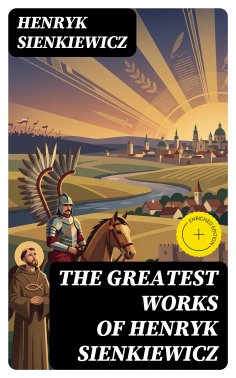
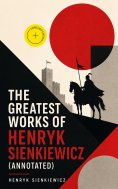
The Greatest Works of Henryk Sienkiewicz (Annotated)


About the eBook
The Greatest Works of Henryk Sienkiewicz gathers the major achievements of a writer whose historical romances transformed the Polish novel into an instrument of cultural memory. In works such as With Fire and Sword, The Deluge, Pan Michael, and Quo Vadis, Sienkiewicz combines expansive adventure, suspenseful plotting, vivid battle scenes, and psychologically legible characters with a profound concern for faith, national survival, moral courage, and the conflict between imperial power and individual conscience. His richly textured prose, informed by Romantic nationalism yet shaped by the techniques of nineteenth-century realism, makes the distant past speak urgently to modern political and ethical experience. The collection also reveals his versatility, from patriotic historical fiction to the religious and civilizational drama of ancient Rome. Born in 1846 in partitioned Poland, Sienkiewicz wrote under conditions in which national sovereignty had been erased by foreign empires. Journalism, travel, and close observation of European and American societies broadened his historical imagination, while the suppression of Polish language and identity gave his fiction its persistent investment in endurance and communal memory. His Catholic background and engagement with European literary traditions further informed his treatment of martyrdom, providence, and moral responsibility. Awarded the Nobel Prize in Literature in 1905, he became both a celebrated international novelist and a symbolic voice of Poland. This volume is recommended to readers interested in historical fiction, Polish culture, nineteenth-century narrative art, and the relationship between literature and national identity. It offers gripping storytelling alongside substantial ethical and historical reflection, making it equally valuable as an introduction to Sienkiewicz and as a representative survey of his enduring literary legacy.
This enriched edition has been carefully crafted to add value to your reading experience.
- A comprehensive Introduction outlines these selected works' unifying features, themes, or stylistic evolutions.
- The Author Biography highlights personal milestones and literary influences that shape the entire body of writing.
- A Historical Context section situates the works in their broader era—social currents, cultural trends, and key events that underpin their creation.
- A concise Synopsis (Selection) offers an accessible overview of the included texts, helping readers navigate plotlines and main ideas without revealing critical twists.
- A unified Analysis examines recurring motifs and stylistic hallmarks across the collection, tying the stories together while spotlighting the different work's strengths.
- Reflection questions inspire deeper contemplation of the author's overarching message, inviting readers to draw connections among different texts and relate them to modern contexts.
- Lastly, our hand‐picked Memorable Quotes distill pivotal lines and turning points, serving as touchstones for the collection's central themes.
About the Author
Henryk Sienkiewicz (1846–1916) was a towering figure in Polish literature, whose works have left an indelible mark on the literary landscape, not only in his homeland but across the world. Born in Wola Okrzejska, Poland, Sienkiewicz was adept at weaving tales that combined historical accuracy with captivating fiction. His mastery of the written word was recognized in 1905 when he was awarded the Nobel Prize in Literature for his 'outstanding merits as an epic writer.' A journalist by profession, Sienkiewicz's literary career took shape amidst the resurgence of Polish national identity under the partitions of Poland by Russia, Austria, and Prussia. His magnum opus, 'Quo Vadis' (1896), a historical novel set in ancient Rome during the reign of Emperor Nero, transcended borders, bringing him international acclaim. It is among the works included in 'The Greatest Works of Henryk Sienkiewicz,' a compilation that showcases the breadth of his literature. His acclaimed 'Trilogy,' consisting of 'With Fire and Sword' (1884), 'The Deluge' (1886), and 'Fire in the Steppe' (also known as 'Pan Wołodyjowski', 1888), remain patriotic mainstays that celebrate Polish heritage and valor. Sienkiewicz's narrative style, characterized by romanticism, rich detail, and vivid characterizations, has had a lasting influence on Polish literature, earning him a distinguished place in literary history.
Related eBooks







Product Details
Publisher: DigiCat
Genre: Sprache - Englisch
Language: English
Size: 5778 Pages
Filesize: 7.2 MB
ISBN: 8596547715504
Published: Nov. 8, 2023