With Fire and Sword, The Deluge & Pan Michael (Annotated)


About the eBook
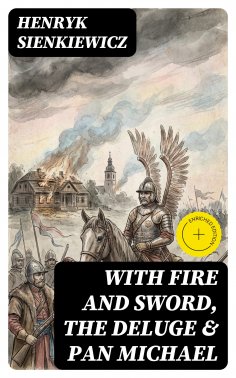
Henryk Sienkiewicz's historical trilogy—With Fire and Sword, The Deluge, and Pan Michael—reconstructs the seventeenth-century Polish-Lithuanian Commonwealth through war, political fracture, religious conflict, and the precarious defense of national sovereignty. Moving from the Cossack uprising and the Swedish invasion to the final struggle against Ottoman power, the novels combine panoramic history with intimate narratives of love, loyalty, betrayal, and military honor. Sienkiewicz's vigorous prose, dramatic pacing, vivid battle scenes, and richly individualized characters unite the conventions of the adventure romance with the moral seriousness of the historical novel. Written during a period when Poland was partitioned and absent from the political map of Europe, the trilogy transforms the past into a meditation on collective memory, cultural endurance, and the imaginative preservation of a nation. Sienkiewicz (1846–1916), the Polish novelist and Nobel laureate, wrote from within the intellectual pressures of foreign domination and the nineteenth-century struggle to sustain Polish identity. His journalistic experience, extensive historical research, and familiarity with European literary traditions enabled him to make national history accessible without reducing it to mere patriotic legend. Although his depictions sometimes reflect the romantic nationalism of his age, they also acknowledge political misjudgment, social tension, and the costs of heroism, giving the trilogy a complexity beyond simple celebration. This substantial cycle deserves recommendation to readers interested in historical fiction, Polish culture, Eastern European history, and the relationship between literature and nation-building. Its pageantry and suspense make it immediately compelling, while its questions about memory, leadership, faith, and civic responsibility reward sustained scholarly attention. Read together, the three novels offer not only an exhilarating narrative of a turbulent century but also a powerful account of how literature can preserve a threatened historical consciousness.
This enriched edition has been carefully crafted to add value to your reading experience.
- A comprehensive Introduction outlines these selected works' unifying features, themes, or stylistic evolutions.
- The Author Biography highlights personal milestones and literary influences that shape the entire body of writing.
- A Historical Context section situates the works in their broader era—social currents, cultural trends, and key events that underpin their creation.
- A concise Synopsis (Selection) offers an accessible overview of the included texts, helping readers navigate plotlines and main ideas without revealing critical twists.
- A unified Analysis examines recurring motifs and stylistic hallmarks across the collection, tying the stories together while spotlighting the different work's strengths.
- Reflection questions inspire deeper contemplation of the author's overarching message, inviting readers to draw connections among different texts and relate them to modern contexts.
- Lastly, our hand‐picked Memorable Quotes distill pivotal lines and turning points, serving as touchstones for the collection's central themes.
About the Author
Henryk Sienkiewicz (1846–1916) was a titan of Polish literature, whose soaring narratives have captivated readers with their vivid portrayal of Poland's history. Born in Wola Okrzejska, Sienkiewicz is perhaps best known for his epic historical novels, especially the Trilogy, which comprises 'With Fire and Sword' (1884), 'The Deluge' (1886), and 'Pan Michael' (1887-1888). These works not only exemplify Sienkiewicz's literary prowess but also reflect his deep patriotism and longing for Poland's independence, which at the time was partitioned by neighboring powers. Sienkiewicz's writings are characterized by their rich historical detail, sweeping plots, and the author's capacity to intertwine personal drama with grand historical events. His skill as a storyteller earned him global recognition, ultimately receiving the Nobel Prize in Literature in 1905 'because of his outstanding merits as an epic writer.' His other notable works include 'Quo Vadis' (1896), a historical novel set in ancient Rome that further cemented Sienkiewicz's reputation as a master of the historical genre. Scholarly discussions of Sienkiewicz's style often comment on his romanticized vision of the past, his flair for dramatic narrative, and his ability to create characters that have become embedded in the cultural consciousness of Poland and the wider world. His works remain a testament to the enduring power of storytelling in shaping national identity and preserving collective memory.
Related eBooks






Product Details
Publisher: DigiCat
Genre: Sprache - Englisch
Language: English
Size: 2470 Pages
Filesize: 3.7 MB
ISBN: 8596547002574
Published: May 18, 2022