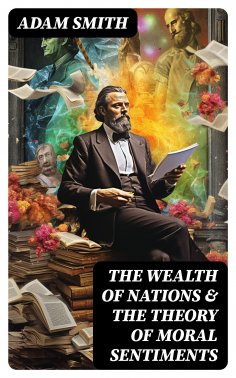
The Wealth of Nations & The Theory of Moral Sentiments


Über das eBook
In his seminal works, "The Wealth of Nations" and "The Theory of Moral Sentiments," Adam Smith masterfully interweaves economics and ethics, setting the foundation for modern capitalism and moral philosophy. "The Wealth of Nations" offers a thorough investigation of commerce and industry, articulating the principles of free market economics, division of labor, and the 'invisible hand' that guides individual pursuits towards collective prosperity. Conversely, "The Theory of Moral Sentiments" explores the complexities of human morality and sympathy, insisting that our moral compass is not just a product of self-interest but is deeply interwoven with social relations. Together, these texts reflect Smith's capacity to merge analytical rigor with a nuanced understanding of human nature, situating his ideas in the Enlightenment tradition of inquiry and critical thought. Adam Smith (1723-1790), a philosopher and economist, profoundly influenced Western thought with his beliefs in economic self-regulation and moral philosophy. His intellectual journey encompassed a rich academic background at the University of Glasgow, where he delved into natural philosophy and human behavior. This dual expertise enabled him to articulate the interconnections between ethical considerations and economic practices that remain pertinent to contemporary discourse. For readers seeking a foundational understanding of economic theory and ethical reasoning, Smith's works are indispensable. They offer not merely historical insights but timeless reflections on the interplay between our economic choices and moral imperatives. Engaging with these texts will deepen your comprehension of the forces that shape societies and the ethical frameworks that govern human conduct.
In this enriched edition, we have carefully created added value for your reading experience:
- A comprehensive Introduction outlines these selected works' unifying features, themes, or stylistic evolutions.
- The Author Biography highlights personal milestones and literary influences that shape the entire body of writing.
- A Historical Context section situates the works in their broader era—social currents, cultural trends, and key events that underpin their creation.
- A concise Synopsis (Selection) offers an accessible overview of the included texts, helping readers navigate plotlines and main ideas without revealing critical twists.
- A unified Analysis examines recurring motifs and stylistic hallmarks across the collection, tying the stories together while spotlighting the different work's strengths.
- Reflection questions inspire deeper contemplation of the author's overarching message, inviting readers to draw connections among different texts and relate them to modern contexts.
- Lastly, our hand‐picked Memorable Quotes distill pivotal lines and turning points, serving as touchstones for the collection's central themes.
Über den Autor
Adam Smith was a preeminent Scottish philosopher and economist renowned for his groundbreaking works that profoundly influenced classical economics and modern economic thought. Born on June 16, 1723, in Kirkcaldy, Scotland, Smith was a key figure of the Scottish Enlightenment. He is most celebrated for his treatise 'An Inquiry into the Nature and Causes of the Wealth of Nations' (1776), commonly referred to as 'The Wealth of Nations,' which is considered the first modern work of economics. In this seminal masterpiece, Smith delineated the principles of free market economies, division of labor, and the function of self-interest in economic exchanges. His other significant contribution is 'The Theory of Moral Sentiments' (1759), where Smith explored the nature of ethical judgments and the origin of human sympathy, offering insight into the moral thinking that precedes his economic theories. Smith's contributions to economic thought, particularly his beliefs on the invisible hand of the marketplace, individual liberty, and competition, established the foundational concepts of capitalism. His literary style, marked by thorough analysis and lucid prose, has allowed his theories to transcend the centuries and remain influential. Smith's insights into moral philosophy and economics have laid a blueprint for understanding the dynamics of wealth creation and ethical considerations within society, earning him the reputation as the father of modern economics (Schumacher, E.F. 1973. 'Small is Beautiful: Economics as if People Mattered').
Diese eBooks könnten Ihnen auch gefallen













Produkt Details
Verlag: DigiCat
Genre: Sprache - Englisch
Sprache: English
Umfang: 477 Seiten
Größe: 1,5 MB
ISBN: 8596547762775
Veröffentlichung: 24. Dezember 2023