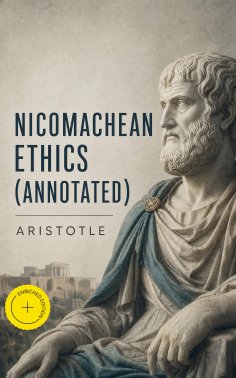
Nicomachean Ethics (Annotated)


Über das eBook
Aristotle's Nicomachean Ethics is a foundational inquiry into the nature of human flourishing, or eudaimonia, and the disciplined cultivation of virtue. Written in a lucid yet compressed philosophical prose, the work proceeds by careful distinctions, practical examples, and teleological reasoning. Set within the intellectual world of classical Greek ethics after Socrates and Plato, it shifts moral philosophy from abstract idealism toward lived character, habit, friendship, pleasure, justice, and contemplative wisdom. Aristotle, born in Stagira in 384 BCE, studied in Plato's Academy before founding his own school, the Lyceum, in Athens. His wide-ranging investigations in logic, biology, politics, rhetoric, and metaphysics shaped his ethical thought: human beings, for him, must be understood according to their distinctive capacities and social nature. The Nicomachean Ethics likely reflects lectures edited or preserved within his school, perhaps associated with his son Nicomachus. This book is indispensable for readers interested in moral philosophy, political thought, classical literature, or the art of living well. It rewards slow reading, inviting reflection not merely on rules or outcomes, but on the formation of a noble, balanced, and intellectually serious life.
This enriched edition has been carefully crafted to add value to your reading experience.
- A succinct Introduction situates the work's timeless appeal and themes.
- The Synopsis outlines the central plot, highlighting key developments without spoiling critical twists.
- A detailed Historical Context immerses you in the era's events and influences that shaped the writing.
- An Author Biography reveals milestones in the author's life, illuminating the personal insights behind the text.
- A thorough Analysis dissects symbols, motifs, and character arcs to unearth underlying meanings.
- Reflection questions prompt you to engage personally with the work's messages, connecting them to modern life.
- Hand‐picked Memorable Quotes shine a spotlight on moments of literary brilliance.
- Interactive footnotes clarify unusual references, historical allusions, and archaic phrases for an effortless, more informed read.
Über den Autor
Aristotle (384–322 BC) was an ancient Greek philosopher and scientist born in the city of Stagira, Chalkidiki, in the north of Classical Greece. Along with Plato, Aristotle is considered the "Father of Western Philosophy", which inherited almost its entire lexicon from his teachings, including problems and methods of inquiry, so influencing almost all forms of knowledge. His writings cover many subjects – including physics, biology, zoology, metaphysics, logic, ethics, aesthetics, poetry, theatre, music, rhetoric, psychology, linguistics, politics and government – and constitute the first comprehensive system of Western philosophy. Aristotle's views on physical science profoundly shaped medieval scholarship and their influence extended from Late Antiquity and the Early Middle Ages into the Renaissance. Aristotle is also known as a tutor of Alexander the Great.
Diese eBooks könnten Ihnen auch gefallen





Produkt Details
Verlag: e-artnow
Genre: Sprache - Englisch
Sprache: English
Umfang: 180 Seiten
Größe: 1,1 MB
ISBN: 9788026893011
Veröffentlichung: 15. Mai 2018