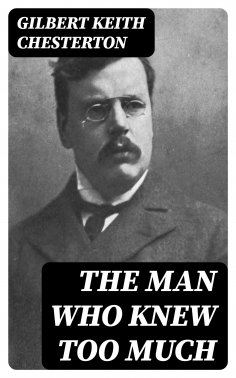
The Man Who Knew Too Much


Über das eBook
In "The Man Who Knew Too Much," G.K. Chesterton crafts a compelling collection of short stories that intertwines mystery, philosophy, and social commentary. The book features the adventurous detective work of Horne Fisher, a character whose acumen transcends mere crime-solving as he grapples with moral complexities and the enigmatic nature of truth. Chesterton employs a distinctive narrative style characterized by wit, paradox, and rich imagery, which reflects the intricacies of Edwardian society and its psychological undercurrents. The stories push the boundaries of the detective genre, inviting readers to ponder the deeper implications of knowledge and ignorance, making it both a thrilling and intellectually stimulating read. A prolific writer known for his defense of faith and critique of modernity, Gilbert Keith Chesterton was profoundly influenced by his surroundings and the philosophical debates of his time. His background as a journalist and essayist dedicated to exploring social justice shines through in this work, where Fisher often finds himself navigating moral dilemmas indicative of early 20th-century anxieties. Chesterton's own explorations of spirituality and human nature are intricately woven into the fabric of the narrative. "The Man Who Knew Too Much" is highly recommended for readers seeking to engage with a layered narrative that challenges conventional notions of justice and morality. Chesterton's ability to intertwine thrilling detective elements with profound philosophical inquiries offers a unique reading experience that resonates well beyond the genre, making it an essential addition to any literary collection.
In this enriched edition, we have carefully created added value for your reading experience:
- A comprehensive Introduction outlines these selected works' unifying features, themes, or stylistic evolutions.
- The Author Biography highlights personal milestones and literary influences that shape the entire body of writing.
- A Historical Context section situates the works in their broader era—social currents, cultural trends, and key events that underpin their creation.
- A concise Synopsis (Selection) offers an accessible overview of the included texts, helping readers navigate plotlines and main ideas without revealing critical twists.
- A unified Analysis examines recurring motifs and stylistic hallmarks across the collection, tying the stories together while spotlighting the different work's strengths.
- Reflection questions inspire deeper contemplation of the author's overarching message, inviting readers to draw connections among different texts and relate them to modern contexts.
- Lastly, our hand‐picked Memorable Quotes distill pivotal lines and turning points, serving as touchstones for the collection's central themes.
Über den Autor
Gilbert Keith Chesterton (1874-1936) was a prolific English writer, poet, philosopher, dramatist, journalist, orator, literary and art critic, biographer, and Christian apologist. Renowned for his tremendous wit and use of paradox, Chesterton is often referred to as the 'prince of paradox.' He wrote numerous books across various genres, becoming well known for his detective series featuring the character Father Brown. One of his noteworthy books, 'The Man Who Knew Too Much,' contains several detective stories that revolve around Horne Fisher, the man who, by his peculiar and paradoxical definition, knew too much about the inner circles of politics and the hidden secrets of the powerful. Chesterton's writing is characteristically marked by its humor, clear reasoning, and keen ability to engage with social and religious critiques of modernity, illustrated vividly in his works such as 'Orthodoxy' and 'The Everlasting Man.' His literary style combines elements of fantasy and satire, which can be seen in his fictional works like 'The Man Who Was Thursday.' Chesterton's influence extends to a wide range of literature and he is often cited as an inspiration by authors across the spectrum, from the likes of Jorge Luis Borges to Neil Gaiman. He was posthumously awarded the title of Knight Commander with Star by the Holy See for his contributions to Catholic thought and literature.
Diese eBooks könnten Ihnen auch gefallen







Produkt Details
Verlag: DigiCat
Genre: Sprache - Englisch
Sprache: English
Umfang: 204 Seiten
Größe: 695,7 KB
ISBN: 8596547086758
Veröffentlichung: 20. Juli 2022