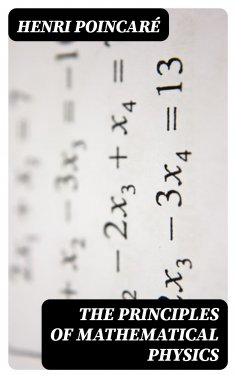
The Principles of Mathematical Physics


Über das eBook
In "The Principles of Mathematical Physics," Henri Poincaré offers a seminal exploration of the interplay between mathematics and the physical sciences, articulating principles that would later underpin modern scientific thought. With a unique blend of rigorous mathematical formulation and philosophical inquiry, Poincaré addresses complex topics such as chaos theory, determinism, and the foundational aspects of mechanics. The literary style is both accessible and profound, reflecting the author's aim to bridge the gap between abstract mathematical concepts and their practical implications in the real world, placing the work in the context of early 20th-century scientific revolutions. Henri Poincaré (1854-1912) was a pioneering French mathematician, theoretical physicist, and philosopher, renowned for his contributions to topology and celestial mechanics. His deep engagement with the emerging fields of relativity and thermodynamics informed his perspective on the nature of physical laws and their mathematical descriptions. Poincaré's diverse academic interests and his ability to synthesize ideas across disciplines positioned him as a preeminent thinker during an era characterized by profound scientific transformation. This book is essential reading for anyone invested in the foundations of modern physics and mathematics. Poincaré's insights not only illuminate the intrinsic relationship between these fields but also provoke critical reflections on the nature of scientific inquiry itself. Readers will find that Poincaré's profound understanding enriches their appreciation for the elegance and complexity of the universe.
In this enriched edition, we have carefully created added value for your reading experience:
- A comprehensive Introduction outlines these selected works' unifying features, themes, or stylistic evolutions.
- The Author Biography highlights personal milestones and literary influences that shape the entire body of writing.
- A Historical Context section situates the works in their broader era—social currents, cultural trends, and key events that underpin their creation.
- A concise Synopsis (Selection) offers an accessible overview of the included texts, helping readers navigate plotlines and main ideas without revealing critical twists.
- A unified Analysis examines recurring motifs and stylistic hallmarks across the collection, tying the stories together while spotlighting the different work's strengths.
- Reflection questions inspire deeper contemplation of the author's overarching message, inviting readers to draw connections among different texts and relate them to modern contexts.
- Lastly, our hand‐picked Memorable Quotes distill pivotal lines and turning points, serving as touchstones for the collection's central themes.
Über den Autor
Henri Poincaré (1854–1912), a prodigious polymath, held a pivotal position in the evolution of modern mathematics and physics. His intellectual contributions traversed various domains, including topology, the theory of functions, and celestial mechanics. Poincaré's erudition extended to philosophy and epistemology, particularly concerning the foundations of science and mathematics. Among his extensive works, 'The Principles of Mathematical Physics' reflects his profound engagement with the conceptual underpinnings of physics and its mathematical formulations. Poincaré's lucid expositions and his ability to synthesize complex ideas mark a literary style that combines rigor with a unique clarity, making accessible the abstractions that characterize the field. His influence is evident in the subsequent development of the theory of relativity and quantum mechanics, where his insights into the dynamic nature of systems and the geometry of space-time laid essential groundwork. Not just a scientist, but a philosopher of science, Poincaré's legacy is enmeshed with the very fabric of mathematical thought. His oeuvre includes seminal books such as 'Science and Hypothesis' and 'The Value of Science,' which further exhibit his impact on the philosophical discourse of scientific principles. As a writer, Poincaré balanced the precision of a mathematician with the reflexivity of a philosopher, making profound contributions to the intellectual milieu of his time and beyond.
Diese eBooks könnten Ihnen auch gefallen









Produkt Details
Verlag: DigiCat
Genre: Sprache - Englisch
Sprache: English
Umfang: 23 Seiten
Größe: 679,0 KB
ISBN: 8596547098881
Veröffentlichung: 21. Juli 2022