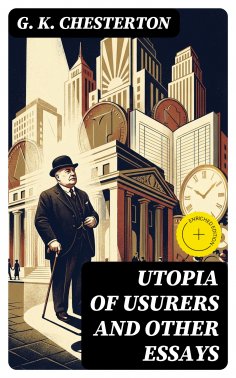
Utopia of Usurers and Other Essays (Annotated)


About the eBook
In *Utopia of Usurers and Other Essays*, G. K. Chesterton assembles a vigorous series of social, economic, and cultural arguments against the abstractions governing modern industrial society. With characteristic paradox, comic exaggeration, historical anecdote, and moral clarity, he attacks financial power, concentrated ownership, imperial assumptions, and the notion that material efficiency constitutes human progress. The title essay exposes the "utopia" promised by usury as a system that liberates finance while impoverishing ordinary producers; throughout, Chesterton contrasts this disembodied economics with the dignity of work, family, locality, and moral responsibility. The collection belongs to the early twentieth-century tradition of Christian social criticism and anticipates the distributist principles he would develop more fully in later works. Chesterton (1874–1936) was an English journalist, novelist, poet, critic, and Christian apologist whose democratic sympathies were shaped by his distrust of both centralized capitalism and collectivist state power. Writing amid the economic dislocation and ideological tensions intensified by the First World War, he sought to recover an older moral vocabulary—property, stewardship, reciprocity, and the common good—against systems that reduced persons to consumers or labor units. His conversion to Catholicism and his engagement with social encyclicals deepened this project, though the essays retain the independent, conversational energy of a public controversialist. This book is especially recommended to readers interested in political theology, economic ethics, distributism, and the history of modern social thought. Its arguments are deliberately provocative rather than technically systematic, but its imaginative force makes it an illuminating challenge to conventional economic language. Readers willing to engage its rhetoric will find a penetrating critique of financial abstraction and a compelling defense of human-scale society.
This enriched edition has been carefully crafted to add value to your reading experience.
- A comprehensive Introduction outlines these selected works' unifying features, themes, or stylistic evolutions.
- The Author Biography highlights personal milestones and literary influences that shape the entire body of writing.
- A Historical Context section situates the works in their broader era—social currents, cultural trends, and key events that underpin their creation.
- A concise Synopsis (Selection) offers an accessible overview of the included texts, helping readers navigate plotlines and main ideas without revealing critical twists.
- A unified Analysis examines recurring motifs and stylistic hallmarks across the collection, tying the stories together while spotlighting the different work's strengths.
- Reflection questions inspire deeper contemplation of the author's overarching message, inviting readers to draw connections among different texts and relate them to modern contexts.
- Lastly, our hand‐picked Memorable Quotes distill pivotal lines and turning points, serving as touchstones for the collection's central themes.
About the Author
Gilbert Keith Chesterton (1874–1936) was a prolific English writer, critic, and philosopher revered for his witty prose, his trenchant social criticism, and his ability to illuminate the paradoxes of life through his narrative artistry. Chesterton's literary contributions span several genres, including journalism, philosophy, poetry, biography, and the detective fiction for which he is perhaps most fondly remembered, with his Father Brown stories standing as perennial classics. He was a master of paradox and a defender of the common man, consistently seeking the wonder in the everyday. Chesterton's 'Utopia of Usurers and Other Essays' (1917) is a compelling example of his social and economic critique, where he expounds on the moral and societal dangers posed by capitalism unbound by ethical constraints. It demonstrates his ability to probe the sociopolitical issues of his time with both incisive logic and a profound sense of morality. His work is marked by a pithy elegance and a unique propensity for employing allegory and satire to dissect the issues facing the society of his day. Acknowledged by literary figures such as Ernest Hemingway and C.S. Lewis for his notable influence, Chesterton's works continue to be studied for their insight, wit, and enduring relevance to contemporary debates.
Related eBooks






















Product Details
Publisher: DigiCat
Genre: Sprache - Englisch
Language: English
Size: 80 Pages
Filesize: 854.5 KB
ISBN: 8596547361824
Published: Sept. 16, 2022