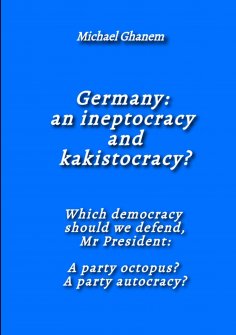
Germany: an ineptocracy and kakistocracy?


About the eBook
There is indeed cause for concern about the state of German democracy. Even our Federal President repeatedly calls for its defence. But what kind of democracy do we actually have?
What can individuals really do – apart from casting their vote every few years in elections to the Bundestag, the state parliaments and local authorities – or not?
The ability of voters to defend democracy in a party-based democracy is more than meagre.
The form of democracy that had a real historical basis when the Federal Republic was founded has ultimately become obsolete due to its development and the current generation of politicians.
The parties have conquered more and more social and economic areas: they determine the entire legislature, the executive and even the judiciary through their lists, and they set the tone in all areas of society.
Even the supposedly neutral public media are dominated by the parties, because the Interstate Broadcasting Treaty, the level of broadcasting fees and the management of public broadcasting are co-determined by the parties and staffed by party members.
At the same time, it is clear that the competence of the political elite is increasingly deteriorating and the media are becoming more and more corrupt. The qualifications of the political elite, especially within the parties, have reached a negative low point. Ultimately, this leads to increasing contempt and alienation among the population.
As bitter as it is, Germany is moving towards an ineptocracy. In this form of government, the most incompetent and unproductive are elected at the expense of the true achievers in society. Politicians focus on political influence, nepotism and opportunistic structures instead of performance or expertise. The government is inefficient, there is a lack of a culture of responsibility and there are systemic problems.
This has consequences for the economy and society: a country with unsuitable leaders can face considerable problems. The economy stagnates because the government pursues an unclear economic policy, enacts too many rules and hinders innovation. A country with poor leadership loses its global significance.
When people perceive decisions as unfair or useless, they lose confidence in the government and political institutions.
The unstable world order and conflicts with Asia, Africa and South America over the distribution of the earth's raw materials and riches will ultimately impoverish the West.
Germany is still regarded worldwide as a vassal state of the USA. However, the German population's decades-long conviction that the USA, NATO and Europe would protect their country is proving to be a mirage.
In view of the dramatic changes in geopolitical power structures, strong and competent political leadership and social cohesion are crucial for future viability. Especially in crisis situations, every country is responsible for itself and needs inner strength.
For the author, it is clear that only critical minds can free Germany from this ineptocracy and kakistocracy without causing conflict. To achieve this, however, a new constitution would have to be adopted and the power of the political parties significantly reduced.
About the Author
Born in 1949, he grew up in France and graduated from an elite French university for industrial engineers. After moving to Germany, he studied economics, sociology, political science, philosophy and ethics. In the field of philosophy, he was strongly influenced by the philosophy and teachings of Zarathustra, Socrates, Plato, Aristotle, Marcus Aurelius, Rabelais, Michel de Montaigne, Baruch Spinoza, Thomas Aquinas, Ibn Khaldun, Niccolo Machiavelli, René Descartes, Blaise Pascal, Voltaire, Jean Jacques Rousseau, Immanuel Kant, Gottfried W. Leibniz, Auguste Comte, Arthur Schopenhauer, Pierre-Joseph Proudhon, Karl Marx, Henri Bergson, Karl Popper, Karl Jaspers, and Erich Fromm. In the field of economics, he was strongly influenced by post-Keynesians and behavioural economists. He is highly critical of the teachings of Milton Friedman, the Chicago Boys, the Frederick School and Friedrich A. Hayek. His professional career first took him to an international organisation, where he worked for five years as a project controller for major water projects, mainly in Africa, and thanks to this, he was able to get to know a large number of countries and their leaders. He then worked for many years for a European organisation and several international consulting firms. He considers himself a critic of current globalisation and has been strongly committed to water management and economics issues since 1974. These experiences have given him a deep understanding of geopolitical issues and enabled him to assess current political developments, particularly in the context of economic interdependencies. Since his retirement, he has been living a secluded life in Bonn and working as a writer. In his publications, he focuses primarily on the pressing social, economic and political issues of our time, as well as water management. To date, he has published numerous works on politics and geopolitics, society and economics. Other key topics include health, identity, racism, the environment, migration, water management, Africa, demographic development and alternative economic systems such as anti-fragility economics. He has also published several short stories and fairy tales.
Related eBooks














Product Details
Publisher: tredition GmbH
Genre: Sprache - Englisch
Language: English
Size: 280 Pages
Filesize: 2.7 MB
ISBN: 9783384804679
Published: Jan. 26, 2026